mirror of
https://github.com/zenlm/zen-blog.git
synced 2026-11-03 14:11:45 +00:00
 zeekay
a30ff37468
b3b6eb0 ran a find-and-replace over the posts forked from the QwenLM
blog that turned "Qwen2" and "Qwen2.5" into "zen": Qwen2-57B-A14B read
as zen7B-A14B, Qwen2-72B as zen-72B, Qwen2AudioForConditionalGeneration
as a class that does not exist, and links such as
github.com/QwenLM/Qwen2 and the qianwen-res image paths pointed at
nothing. Every token is put back from the original post, aligned
against the rewritten one: 536 lines across 29 posts, and 116 of the
example files under public/cases.

These 44 posts are about another lab's releases and now say so with
"upstream: true" in their frontmatter. Two Zen posts lose the
base-model names they carried, and the Zen 3 post stops calling itself
the next generation.
13 lines
4.3 KiB
JSON
13 lines
4.3 KiB
JSON
{
|
||
"title": "Mathematical Reasoning",
|
||
"messages": [
|
||
{
|
||
"role": "User",
|
||
"content": "侏罗纪蜘蛛网是一种非常有规律的蜘蛛网,如图,它是由无数个正方形环绕而成的,且最外边第一个正方形A_{1}B_{1}C_{1}D_{1}的面积为a_{1}=1,分别取正方形A_{1}B_{1}C_{1}D_{1}各边的三等分点A_{2},B_{2},C_{2},D_{2},作第二个正方形A_{2}B_{2}C_{2}D_{2},且正方形A_{2}B_{2}C_{2}D_{2}的面积为a_{2},\\ldots \\ldots ,依次类推,第n个正方形A_{n}B_{n}C_{n}D_{n}的面积为a_{n}. $求{a_{n}}的通项公式\n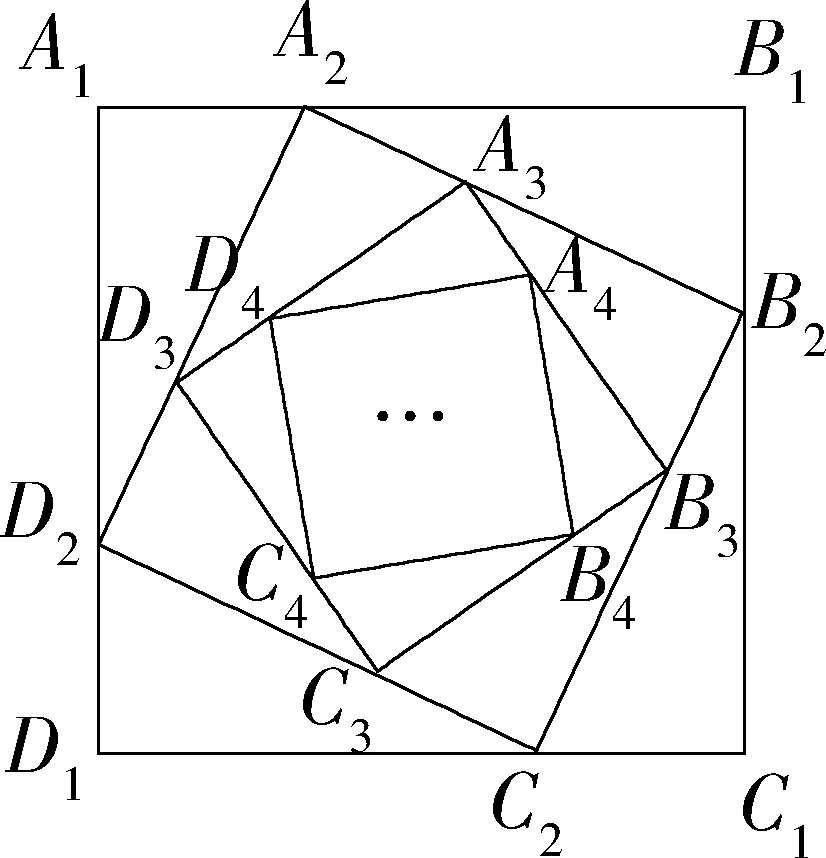"
|
||
},
|
||
{
|
||
"role": "Qwen2.5-VL-32B",
|
||
"content": "### 问题分析\n我们需要找到第 $ n $ 个正方形的面积 $ a_n $ 的通项公式。已知:\n- 第一个正方形 $ A_1B_1C_1D_1 $ 的面积为 $ a_1 = 1 $。\n- 每次取前一个正方形各边的三等分点,构造一个新的正方形。\n\n我们需要确定每次构造新正方形时,其面积与前一个正方形面积之间的关系。\n\n---\n\n### 第一步:设第一个正方形的边长\n设第一个正方形 $ A_1B_1C_1D_1 $ 的边长为 $ s_1 $。由于其面积为 $ a_1 = 1 $,因此:\n$$\ns_1 = \\\\sqrt{a_1} = \\\\sqrt{1} = 1.\n$$\n\n---\n\n### 第二步:构造第二个正方形\n取 $ A_1B_1C_1D_1 $ 各边的三等分点,得到新的正方形 $ A_2B_2C_2D_2 $。我们需要计算这个新正方形的边长。\n\n#### 1. 确定新正方形的顶点坐标\n假设第一个正方形 $ A_1B_1C_1D_1 $ 的顶点坐标如下:\n- $ A_1 = (0, 1) $,\n- $ B_1 = (1, 1) $,\n- $ C_1 = (1, 0) $,\n- $ D_1 = (0, 0) $.\n\n取各边的三等分点:\n- $ A_2 $ 是 $ A_1B_1 $ 的三等分点,坐标为 $ \\\\left( \\frac{1}{3}, 1 \\right) $,\n- $ B_2 $ 是 $ B_1C_1 $ 的三等分点,坐标为 $ \\\\left( 1, \\frac{2}{3} \\right) $,\n- $ C_2 $ 是 $ C_1D_1 $ 的三等分点,坐标为 $ \\\\left( \\frac{2}{3}, 0 \\right) $,\n- $ D_2 $ 是 $ D_1A_1 $ 的三等分点,坐标为 $ \\\\left( 0, \\frac{1}{3} \\right) $.\n\n#### 2. 计算新正方形的边长\n新正方形 $ A_2B_2C_2D_2 $ 的边长可以通过计算任意两点之间的距离得到。例如,计算 $ A_2 $ 和 $ B_2 $ 之间的距离:\n$$\nA_2 = \\\\left( \\frac{1}{3}, 1 \\right), \\\\quad B_2 = \\\\left( 1, \\frac{2}{3} \\right).\n$$\n两点间的距离公式为:\n$$\ns_2 = \\\\sqrt{\\\\left( x_2 - x_1 \\right)^2 + \\\\left( y_2 - y_1 \\right)^2}.\n$$\n代入坐标:\n$$\ns_2 = \\\\sqrt{\\\\left( 1 - \\frac{1}{3} \\right)^2 + \\\\left( \\frac{2}{3} - 1 \\right)^2} = \\\\sqrt{\\\\left( \\frac{2}{3} \\right)^2 + \\\\left( -\\frac{1}{3} \\right)^2} = \\\\sqrt{\\frac{4}{9} + \\frac{1}{9}} = \\\\sqrt{\\frac{5}{9}} = \\frac{\\\\sqrt{5}}{3}.\n$$\n\n#### 3. 计算新正方形的面积\n新正方形的面积 $ a_2 $ 为:\n$$\na_2 = s_2^2 = \\\\left( \\frac{\\\\sqrt{5}}{3} \\right)^2 = \\frac{5}{9}.\n$$\n\n---\n\n### 第三步:归纳规律\n从上述计算可以看出:\n- 第一个正方形的边长为 $ s_1 = 1 $,面积为 $ a_1 = 1 $。\n- 第二个正方形的边长为 $ s_2 = \\frac{\\\\sqrt{5}}{3} $,面积为 $ a_2 = \\frac{5}{9} $。\n\n接下来,我们猜测每次构造新正方形时,边长和面积的变化规律。\n\n#### 1. 边长变化规律\n假设第 $ n $ 个正方形的边长为 $ s_n $,则第 $ n+1 $ 个正方形的边长 $ s_{n+1} $ 可以通过相似三角形的性质得出。每次取三等分点构造的新正方形,其边长是前一个正方形边长的 $ \\frac{\\\\sqrt{5}}{3} $ 倍。因此:\n$$\ns_{n+1} = \\frac{\\\\sqrt{5}}{3} s_n.\n$$\n\n#### 2. 面积变化规律\n由于面积与边长的平方成正比,第 $ n+1 $ 个正方形的面积 $ a_{n+1} $ 为:\n$$\na_{n+1} = s_{n+1}^2 = \\\\left( \\frac{\\\\sqrt{5}}{3} s_n \\right)^2 = \\\\left( \\frac{\\\\sqrt{5}}{3} \\right)^2 a_n = \\frac{5}{9} a_n.\n$$\n\n这表明 $ \\\\{a_n\\\\} $ 是一个等比数列,首项为 $ a_1 = 1 $,公比为 $ \\frac{5}{9} $。\n\n---\n\n### 第四步:写出通项公式\n等比数列的通项公式为:\n$$\na_n = a_1 \\\\cdot q^{n-1},\n$$\n其中 $ a_1 = 1 $,$ q = \\frac{5}{9} $。因此:\n$$\na_n = 1 \\\\cdot \\\\left( \\frac{5}{9} \\right)^{n-1} = \\\\left( \\frac{5}{9} \\right)^{n-1}.\n$$\n\n---\n\n### 最终答案\n$$\n\\boxed{\\\\left( \\frac{5}{9} \\right)^{n-1}}\n$$\n"
|
||
}
|
||
]
|
||
} |