 zeekay
0bb9036244
Conservative rebrand of Cap'n Proto branding to ZAP. ZAP is a wire/library
compatible Cap'n Proto fork, so only user-facing identity strings change;
all protocol/schema/toolchain identifiers are preserved.

Rebranded (display only):
- Proto description "Cap'n Proto RPC Protocol" -> "ZAP RPC Protocol"
- protocol column label "CAPNP" -> "ZAP"
- TCP/UDP port pref help prose -> "ZAP RPC messages"
- README plugin title/description, screenshot URL -> zap-proto/wireshark,
  sample tshark/-O output updated to match the rebranded column

Preserved (functional / attribution):
- Proto("capnp", ...) display-filter id and "capnp.text" field name
  (documented tshark -Y capnp / -O capnp workflow depends on it)
- require("capnp_schema") module + capnp_schema["rpc"] coupling
- plugins/rpc_capnp.lua compiled Cap'n Proto schema (displayName paths +
  displayNamePrefixLength offsets are load-bearing)
- Makefile capnp compiler pipeline and .capnp schema-file extension
- upstream copyright (Andreas Stenius) and Cap'n Proto attribution

Docs: Wireshark dissector for ZAP · part of the ZAP Protocol
wireshark-plugins
My custom wireshark plugins.
INSTALL
Make sure wireshark finds the plugins, i.e. by symlinking your wireshark plugins dir to this repo's plugins dir:
$ ln -s .../path/to/repo/wireshark-plugins/plugins ~/.wireshark/plugins
Plugins
ZAP RPC protocol dissector
The full RPC schema is available, giving pretty good insight into what is going on, at the RPC level.
ZAP is wire-compatible with Cap'n Proto; this dissector decodes the Cap'n Proto RPC wire protocol that ZAP speaks.
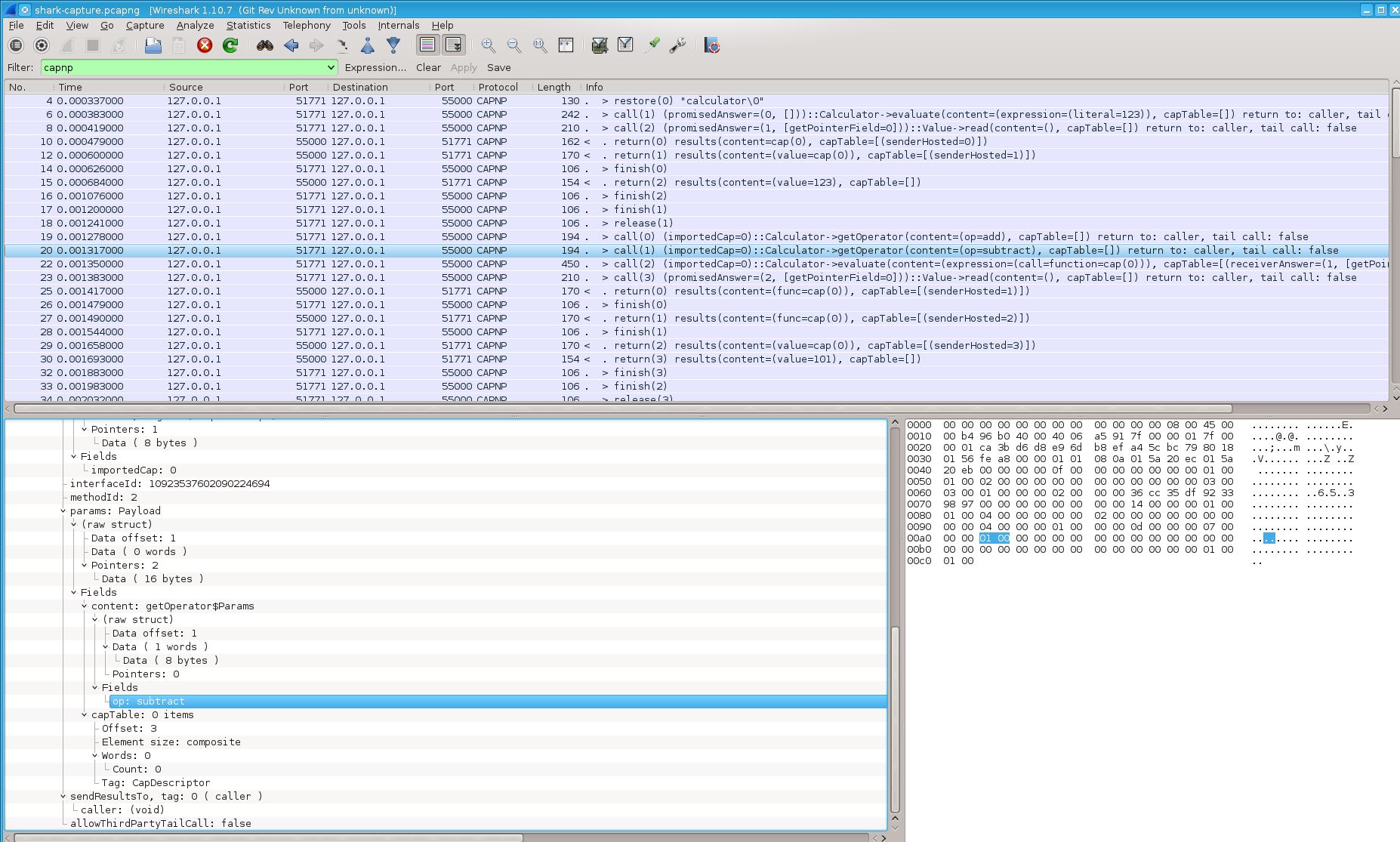
Capture some data
Example command to capture the data from the capnp calculator sample
(assuming the server is already running, and listening on
localhost:55000):
    { wireshark -i lo -k -a duration:2 & }; \
    sleep 2 && ./calculator-client localhost:55000
It can look something like this (output from tshark -r <capture-file.pcapng> -Y capnp):
  4 0.000337000    127.0.0.1 51771 127.0.0.1    55000 ZAP 130 > restore(0) "calculator\0"
  6 0.000383000    127.0.0.1 51771 127.0.0.1    55000 ZAP 242 > call(1) (promisedAnswer=(0, []))::Calculator->evaluate(capTable=[], content=(expression=(literal=123))) return to
: caller, tail call: false
  8 0.000419000    127.0.0.1 51771 127.0.0.1    55000 ZAP 210 > call(2) (promisedAnswer=(1, [getPointerField=0]))::Value->read(capTable=[], content=()) return to: caller, tail c
all: false
 10 0.000479000    127.0.0.1 55000 127.0.0.1    51771 ZAP 162 <  return(0) results(capTable=[(senderHosted=0)], content=cap(0))
 12 0.000600000    127.0.0.1 55000 127.0.0.1    51771 ZAP 170 <  return(1) results(capTable=[(senderHosted=1)], content=(value=cap(0)))
 14 0.000626000    127.0.0.1 51771 127.0.0.1    55000 ZAP 106 > finish(0)
 15 0.000684000    127.0.0.1 55000 127.0.0.1    51771 ZAP 154 <  return(2) results(capTable=[], content=(value=123))
 16 0.001076000    127.0.0.1 51771 127.0.0.1    55000 ZAP 106 > finish(2)
 17 0.001200000    127.0.0.1 51771 127.0.0.1    55000 ZAP 106 > finish(1)
 18 0.001241000    127.0.0.1 51771 127.0.0.1    55000 ZAP 106 > release(1)
And using -O capnp instead:
Frame 6: 242 bytes on wire (1936 bits), 242 bytes captured (1936 bits) on interface 0
Ethernet II, Src: 00:00:00_00:00:00 (00:00:00:00:00:00), Dst: 00:00:00_00:00:00 (00:00:00:00:00:00)
Internet Protocol Version 4, Src: 127.0.0.1 (127.0.0.1), Dst: 127.0.0.1 (127.0.0.1)
Transmission Control Protocol, Src Port: 51771 (51771), Dst Port: 55000 (55000), Seq: 65, Ack: 1, Len: 176
ZAP RPC Protocol: call(1) (promisedAnswer=(0, []))::Calculator->evaluate(content=(expression=(literal=123)), capTable=[]) return to: caller, tail call: false
    Segments: 1
        Segment: 0 ( 21 words )
            Data ( 168 bytes )
    Root: Message, union: call
        (raw struct)
            Data offset: 0
            Data ( 1 words )
                Data ( 8 bytes )
                Union, tag: 2 ( call )
            Pointers: 1
                Data ( 8 bytes )
        Fields
            call: Call
                (raw struct)
                    Data offset: 0
                    Data ( 3 words )
                        Data ( 24 bytes )
                    Pointers: 3
                        Data ( 24 bytes )
                Fields
                    questionId: 1
                    target: MessageTarget, union: promisedAnswer
                        (raw struct)
                            Data offset: 9
                            Data ( 1 words )
                                Data ( 8 bytes )
                                Union, tag: 1 ( promisedAnswer )
                            Pointers: 1
                                Data ( 8 bytes )
                        Fields
                            promisedAnswer: PromisedAnswer
                                (raw struct)
                                    Data offset: 0
                                    Data ( 1 words )
                                        Data ( 8 bytes )
                                    Pointers: 1
                                        Data ( 8 bytes )
                                Fields
                                    questionId: 0
                                    transform: 0 items
                                        Offset: 0
                                        Element size: 32
                                        Count: 0
                    interfaceId: 10923537602090224694
                    methodId: 0
                    params: Payload
                        (raw struct)
                            Data offset: 1
                            Data ( 0 words )
                            Pointers: 2
                                Data ( 16 bytes )
                        Fields
                            content: evaluate$Params
                                (raw struct)
                                    Data offset: 1
                                    Data ( 0 words )
                                    Pointers: 1
                                        Data ( 8 bytes )
                                Fields
                                    expression: Expression, union: literal
                                        (raw struct)
                                            Data offset: 0
                                            Data ( 2 words )
                                                Data ( 16 bytes )
                                                Union, tag: 0 ( literal )
                                            Pointers: 2
                                                Data ( 16 bytes )
                                        Fields
                                            literal: 123
                            capTable: 0 items
                                Offset: 9
                                Element size: composite
                                Words: 0
                                    Count: 0
                                Tag: CapDescriptor
                    sendResultsTo, tag: 0 ( caller )
                        caller: (void)
                    allowThirdPartyTailCall: false

...
Custom schemas
Simply plugin additional capnp schemas to be used by the dissector by
compiling them to lua code using the provided Makefile:
make schema input=/path/to/my-schema.capnp
This will compile the schema to plugins/my-schema_capnp.lua and is
automatically picked up by the dissector.
Notice As wireshark re-dissects messages ad-hoc while browsing (why, oh-why?! waily waily) it is hard to keep track of request/answer id's, which requires an in-sequence approach. I've made an attempt at keeping track of the packet number-range for each request id, so it should work pretty well now, I think..